Coupling with a fuel performance code
SCIANTIX can be embedded in a fuel performance code (FPC), which calls it at each time step for each computational node of the fuel (for example, each radial and axial node of a fuel rod). This page describes the interface, for developers who know their own FPC well and want to couple it to SCIANTIX.
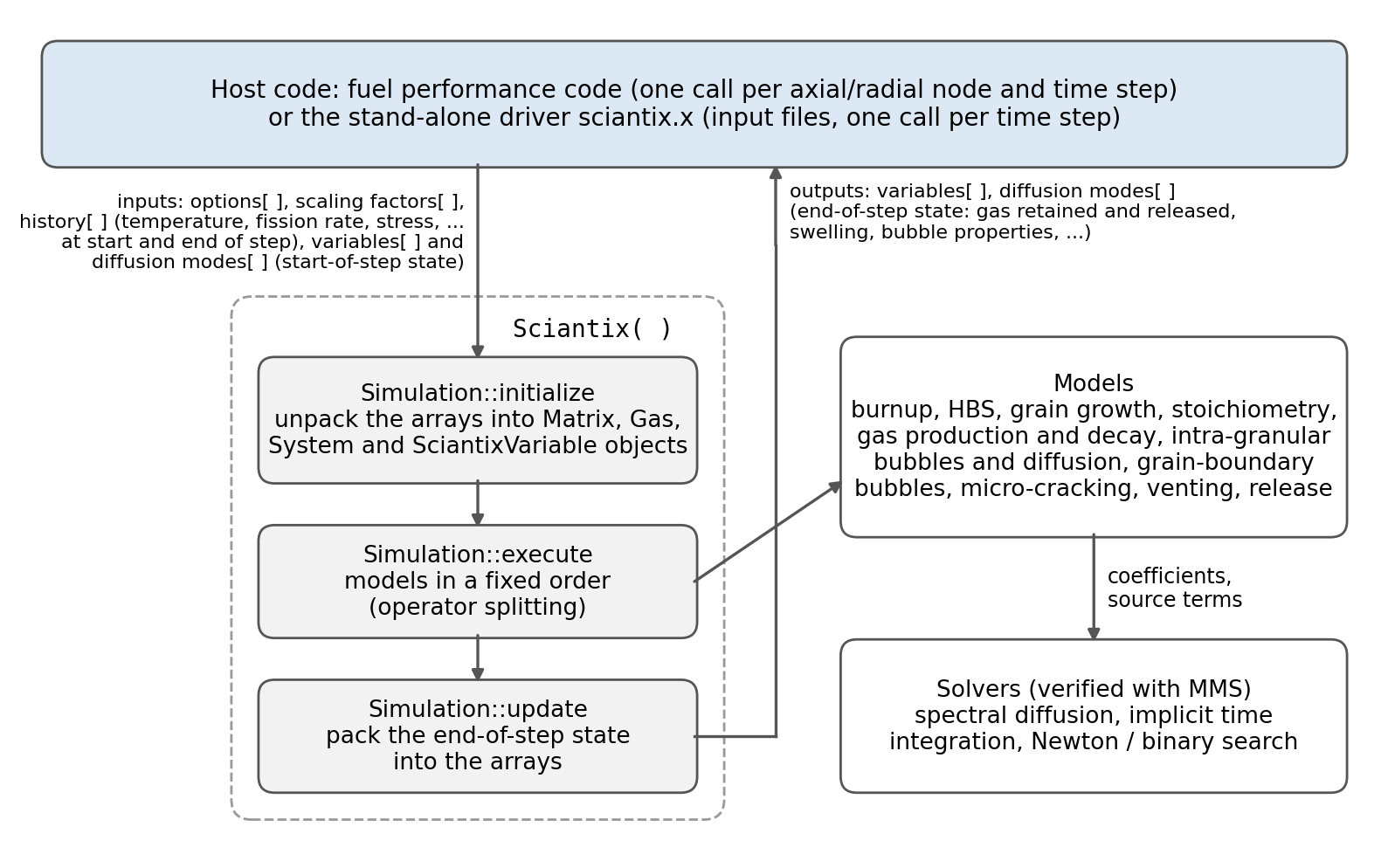
Architecture of SCIANTIX and its interface with a host code.
Building the library
cmake -S . -B build -DCOUPLING_TU=ON
cmake --build build
This builds the static library build/libsciantix.a instead of the executable, to be linked with the FPC.
Entry points
The interface consists of two functions with C linkage, declared in include/coupling/TUSrcCoupling.h,
which can therefore be called from C, C++ and Fortran (through ISO_C_BINDING):
getSciantixOptions(options, scaling_factors, thermochemistry, thermochemistry_settings)Called once at the start of the calculation. It reads
input_settings.txtand, if present,input_scaling_factors.txtfrom the working directory, and fills the arrays of options and scaling factors. The options are the same as in a stand-alone calculation (see input_settings.txt), exceptNumber_of_time_steps_per_interval: the time discretisation is that of the FPC.callSciantix(options, history, variables, scaling_factors, diffusion_modes, thermochemistry, thermochemistry_settings)Called at each time step, for each node. It advances the state of the node from the beginning to the end of the time step.
Data exchanged
All the arrays are owned by the FPC. Their sizes are set in include/MainVariables.h.
options(int)Model options, as read by
getSciantixOptions. The same for all nodes.history(double)Local conditions of the node at the beginning and end of the time step, set by the FPC before each call:
Index
Quantity
Unit
0, 1
temperature (beginning, end of step)
K
2, 3
fission rate (beginning, end of step)
fiss/(m3s)
4, 5
hydrostatic stress (beginning, end of step)
MPa
6
time step
s
7
time
h
8
time step number
–
9, 10
steam pressure (beginning, end of step)
atm
11, 12
system pressure (beginning, end of step)
Pa
13, 14
O/M ratio (beginning, end of step)
–
Steam pressure, system pressure and O/M ratio are used only by the models that need them (fuel oxidation, thermochemistry, prescribed stoichiometry).
variables(double)State of the node: grain radius, gas produced, in the grains, at the grain boundaries and released, bubble properties, swelling, and so on. The FPC sets the initial values once, keeps one array per node, and passes it at each call: on input it holds the state at the beginning of the step, on output the state at the end. The position of each variable is fixed and listed in
initializeSciantixVariable(src/operations/SetVariablesFunctions.C); new variables are added at new positions, so that existing couplings are not affected.diffusion_modes(double)Coefficients of the spectral solution of intra-granular diffusion. Like
variables, one array per node, initialised to zero and passed back at each call.scaling_factors(double)Scaling factors of the model parameters (see the Input Files page). The same for all nodes.
thermochemistry,thermochemistry_settingsUsed only when thermochemistry is enabled (
iThermochimica); otherwise an array of zeros and a null pointer.
Typical coupling
At the start of the calculation, call
getSciantixOptionsand allocatevariablesanddiffusion_modesfor each node, with the initial conditions invariables(e.g. the initial grain radius at position 0).At each time step and for each node, fill
historywith the local conditions computed by the FPC, callcallSciantix, and read the results fromvariables.Use the results in the FPC: for example, the gas released goes to the rod free volume and the gaseous swelling to the fuel strain.
SCIANTIX keeps no state between calls other than the arrays passed by the FPC, so the nodes are
independent and the order of the calls does not matter. The stand-alone executable
(src/MainSCIANTIX.C) is itself a driver of this kind, with a single node and the history read
from input_history.txt, and can be used as a reference implementation.
Existing couplings
SCIANTIX is coupled with TRANSURANUS, OFFBEAT and FRAPCON/FRAPTRAN; see Publications for the corresponding papers. For access to a coupled version of one of these codes, contact the developers through the issue tracker.